PENGARUH DEBT TO EQUITY RATIO (DER), PRICE EARNING RATIO (PER), DAN EARNING PER SHARE (EPS) TERHADAP HARGA SAHAM PADA PERUSAHAAN SUB SEKTOR INDUSTRI BARANG KONSUMSI YANG TERDAFTAR DI BEI
DOI:
https://doi.org/10.64237/arbus.v4i2.111Keywords:
Debt to Equity Ratio (DER), Price Earning Ratio (PER), Earning Per Share (EPS), Stock Price.Abstract
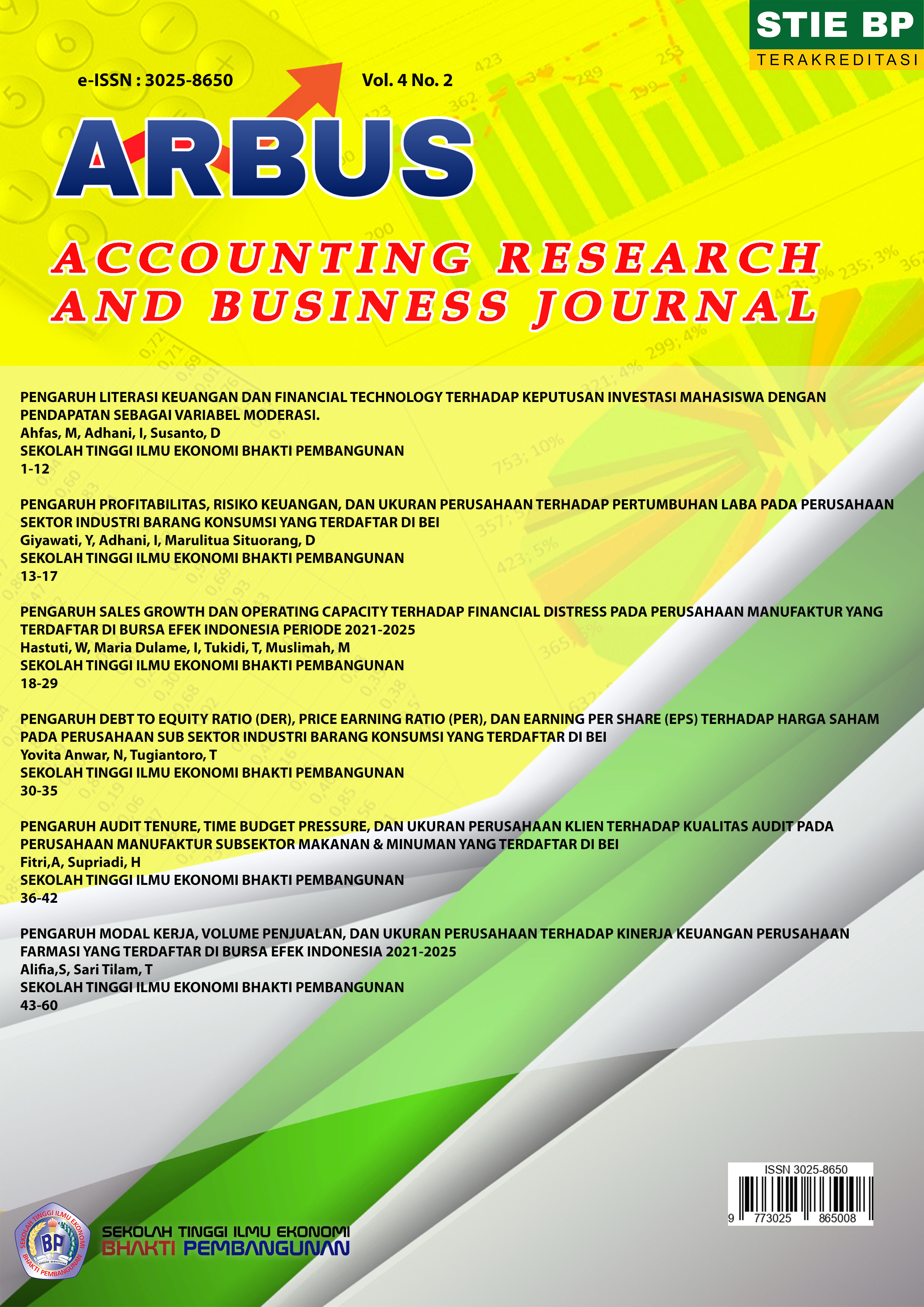
PENGARUH DEBT TO EQUITY RATIO (DER), PRICE EARNING RATIO (PER), DAN EARNING PER SHARE (EPS) TERHADAP HARGA SAHAM PADA PERUSAHAAN SUB SEKTOR INDUSTRI BARANG KONSUMSI YANG TERDAFTAR DI BEI
Nova Yovita Anwar1, Tugiantoro2 STIE Bhakti Pembangunan
ABSTRACT
This study aims to analyze the influence of Debt to Equity Ratio (DER), Price Earning Ratio (PER), and Earning Per Share (EPS) on stock prices in the Consumer Goods Industry sub-sector companies listed on the Indonesia Stock Exchange (IDX) for the 2017-2022 period, both partially and simultaneously. The background of this research is based on the rapid development of Indonesia's capital market and the importance of financial performance indicators in determining stock prices. The research method used is multiple linear regression. The sample consists of 7 companies determined by purposive sampling from a population of 54 Consumer Goods Industry companies, with an observational period of 6 years resulting in 42 data points. The results show that partially, the DER variable has no significant effect on Stock Prices, whereas the PER and EPS variables have a significant positive effect on Stock Prices. Simultaneously, the DER, PER, and EPS variables significantly influence Stock Prices. The adjusted R-square value in explaining the variation of the dependent variable is 77.6%, while the remaining 22.4% is explained by other independent variables outside this study.
Downloads
Published
Issue
Section
License
Copyright (c) 2026 Accounting Research and Business

This work is licensed under a Creative Commons Attribution-ShareAlike 4.0 International License.